This article was written by Mia MATIAS, Communication Intern at E|C Consulting
Did you know that Europeans donate, bequeath, and invest over €100 billion every year for the common good? That’s more than the GDP of many countries and yet, philanthropy in Europe remains largely invisible in public debate. A landmark new study published in March 2026 by the European Research Network on Philanthropy (ERNOP) changes that. For the first time in nearly a decade, we have a comprehensive, evidence-based picture of what generosity looks like across the continent, who gives, how much, through which channels, and where the blind spots remain.
I attended the ERNOP webinar presenting these findings and want to share the key insights with you in a simple, accessible way. Whether you are curious about philanthropy, work in the nonprofit sector, or simply want to understand the forces shaping European civil society, this article is for you.
What Is ERNOP and Why Should You Trust This Study?
Before diving into the numbers, a word about the source. ERNOP, the European Research Network on Philanthropy is an independent academic network founded in 2008. It brings together around 300 researchers from 30 European countries who study philanthropy, charitable giving, and civil society. Think of it as the scientific community dedicated to understanding generosity in Europe.
The study Philanthropy in Europe was edited by Barry Hoolwerf and Johan Vamstad and produced with the input of nearly 50 researchers across 23 countries. It covers data from 2022, making it the most up-to-date and geographically comprehensive analysis available. It builds on a previous ERNOP study published in 2017 (Giving in Europe), which had put the total at €87.5 billion based on 2013 figures, so we can already see that giving has grown significantly.
The full publication is freely available online as an Open Access document, meaning anyone can read it, check the methodology, and form their own view. That kind of transparency is exactly what makes it trustworthy.
The Headline Number: €104.5 Billion and That’s Just the Tip of the Iceberg
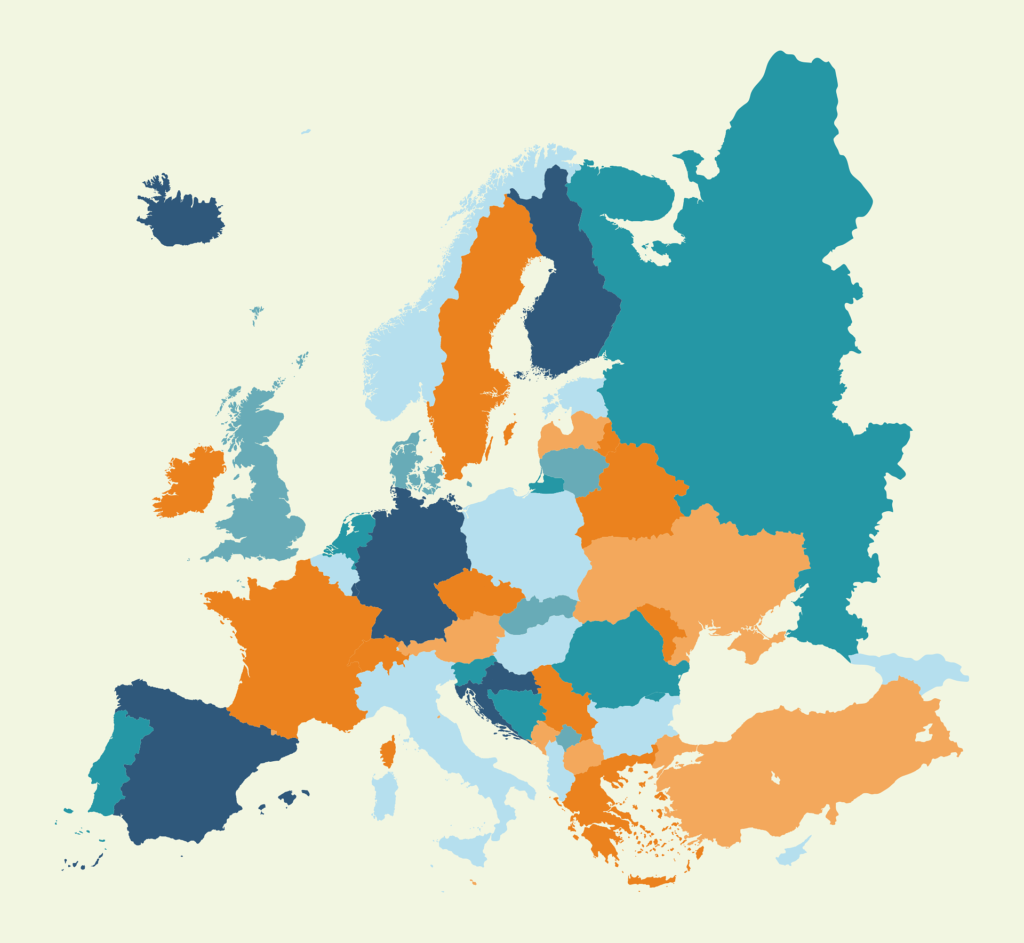
Let’s start with the big figure: philanthropic giving across 23 European countries amounts to at least €104.5 billion annually.
But here is the crucial detail: that is a lower-bound estimate. The researchers are explicit that the real figure is almost certainly higher, possibly much higher. Why? Because not all giving is visible. Many donations go unrecorded, unreported, or are made through informal channels that no database captures. The €104.5 billion represents what can actually be measured with available data.
Think of it like an iceberg: what the study documents is above the waterline. The rest is submerged, real, substantial, but not yet visible to researchers or policymakers.
This is not a failure of the study. It is one of its most honest and important contributions: it tells us not only what we know, but also how much we still don’t know.
Where Does the Money Come From? Five Sources of European Generosity
The study breaks philanthropic giving down into five distinct categories. Each one tells a different story about how Europeans express their generosity.
- Households: €52 billion
The Heart of European Giving
Individual donations from households are the single largest source of philanthropy in Europe, accounting for roughly half of the total. This category includes everything from a monthly bank transfer to your local food bank, to a one-off donation after a natural disaster, to a major gift from a wealthy individual to a cultural institution.
Household giving is also the best documented of all five categories, national surveys and tax records provide relatively reliable data in many countries. This makes it the most solid foundation of the entire study.
The lesson? Ordinary people, not just billionaires, are the backbone of European philanthropy.
- Corporate Giving: €21.5 billion
A Likely Undercount
Businesses across Europe give an estimated €21.5 billion annually. But the researchers are clear: the true figure is likely considerably higher. Why? Because corporate giving takes many forms that are hard to track: donating products or services rather than cash, lending staff to charities, running employee volunteering programmes, or contributing through complex partnership arrangements.
As companies face growing pressure to demonstrate their social and environmental responsibility, corporate giving is evolving rapidly. The fact that it remains so difficult to measure is itself a challenge for accountability and transparency.
- Foundations: €20.6 billion
Concentrated but Powerful
Foundations and organisations set up specifically to distribute funds for public benefit contribute over €20 billion annually. Two countries stand out: Germany and Switzerland are home to the most active foundation sectors in Europe, reflecting both historical tradition and strong legal frameworks that make it attractive to set up and run a foundation.
Foundations often have long time horizons and strategic focus areas, from scientific research to the arts, from poverty relief to climate action. They are frequently described as the “patient capital” of the philanthropic world, able to fund work that neither governments nor markets will support.
- Bequests: €8.4 billion
The Sleeping Giant
Legacy giving, leaving money or assets to a charitable cause in your will contributes €8.4 billion per year. But the study highlights a striking finding: bequests are “significantly under-measured across most of Europe.” In other words, this €8.4 billion is almost certainly a fraction of what is actually given.
In countries with established legacy cultures like the United Kingdom, France, the Netherlands, charitable bequests are a major and growing funding stream. In others, the concept remains relatively unfamiliar, and legal or tax frameworks may not encourage it.
As Europe’s population ages and wealth transfers between generations accelerate, legacy giving is likely to become increasingly important. It is, in many ways, the sleeping giant of European philanthropy.
- Charity Lotteries: €1.9 billion
Small but Specific
Charity lotteries where ticket revenue is directed to good causes generate nearly €2 billion annually, concentrated in a handful of countries: the Netherlands, Germany, and Sweden are the dominant players. It is the smallest category by volume, but it plays a specific and important role in engaging mass audiences with philanthropy in a low-barrier, entertaining way.
The Data Problem: We Know Less Than We Think
One of the most thought-provoking aspects of the ERNOP study is how much attention it pays to the limits of our knowledge.
The researchers assessed not only how much is given, but also how well each country measures its philanthropic activity. The findings are sobering. Some countries maintain robust, regularly updated, nationally representative data systems. Others rely on outdated surveys, partial estimates, or simply have no systematic tracking at all. In some cases, data infrastructure appears to be getting worse, not better.
Barry Hoolwerf, the Director of ERNOP and co-editor of the study, makes the point directly: the data gaps are not a footnote, they are a central finding. Without better data, it is impossible to have an informed public debate about the role of philanthropy, to design effective policies, or to hold philanthropic actors accountable.
For citizens and civil society organisations, this should be a prompt: push for better transparency and more systematic measurement of giving. What gets measured gets managed and what doesn’t get measured can be overlooked or misunderstood.
Why Does This Matter Right Now?
The timing of this study is not accidental. It arrives at a moment of real uncertainty for European societies.
Governments across the continent are under fiscal pressure, reassessing public spending commitments, and in some cases scaling back support for social services, international aid, and environmental programmes. At the same time, crises from the aftermath of COVID-19 to the ongoing conflicts in Ukraine and the Middle East continue to generate urgent humanitarian needs.
In this context, philanthropy is being asked to do more. And the ERNOP study gives us the clearest picture yet of what “more” actually looks like: where the money exists, where it flows, and where the infrastructure to channel and measure it is weakest.
This is not about replacing the state with private charity. Philanthropy is not a substitute for public funding. But understanding its scale and structure helps societies make better decisions about how public and private resources can complement one another.
5 Things to Remember from This Study
Let’s wrap up with the five key takeaways you can share with colleagues, friends, or anyone curious about European generosity:
- Europeans give at least €104.5 billion per year a figure that has grown from €87.5 billion in 2013, and which is almost certainly an undercount.
- Households are the biggest givers, contributing around half the total, ordinary people, not just the ultra-wealthy, drive European philanthropy.
- Corporate giving is underestimated, €21.5 billion is recorded, but the real figure is almost certainly much higher.
- Legacy giving is a growing force, wills and bequests contribute €8.4 billion annually, but remain poorly tracked and significantly under-resourced in many countries.
- Data gaps are a real problem, knowing how much is given, and where, is a prerequisite for good policy, good strategy, and genuine accountability.
One Final Thought
Numbers like €104.5 billion can feel abstract. But philanthropy is, at its core, about people deciding to contribute to something beyond themselves, a cause, a community, a future they want to help create. The ERNOP study puts a rigorous framework around that deeply human impulse, and in doing so, helps all of us, citizens, practitioners, policymakers, and advisors understand it better.
At E|C Consulting, we believe that good information leads to better decisions. That’s why we follow research like this closely, and why we’re delighted to share it with you.
Stay curious. Stay informed. And keep giving.
To go further:
- Full ERNOP study (Open Access): ernop.eu/philanthropy-in-europe-4 (freely downloadable)
- Previous study: ERNOP (2017). Giving in Europe. Lenthe Publishers. Amsterdam.
- ERNOP website: ernop.eu
- European Fundraising Association coverage: efa-net.eu
Do you need expertise and support for your organization? Let’s talk about it!
To keep up to date with the latest articles, follow me on LinkedIn and subscribe to the newsletter.
Copyright © 2026 E | C Consulting – All Rights Reserved – To use this content, please ask for permission in advance and cite the source if agreed.
